TAG by Oui Capital · Volume II
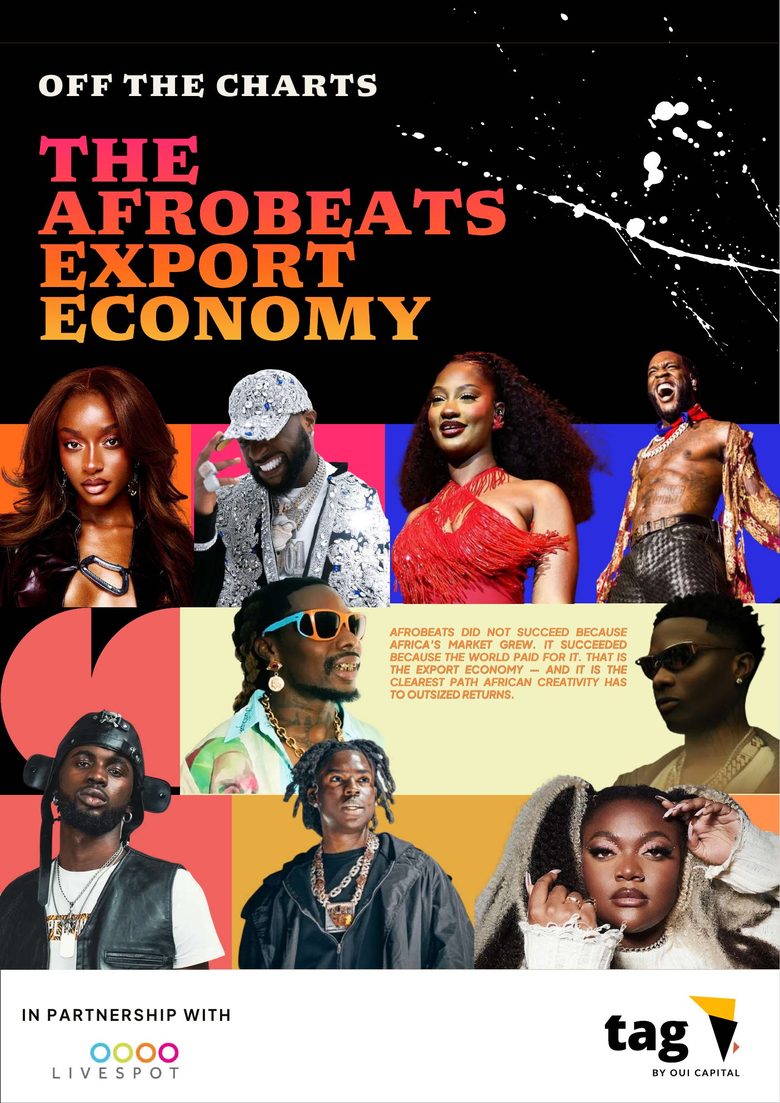
Afrobeats didn't win because Africa's market grew. It won because the world paid for it. This report looks at who gets to keep more of that value, and the businesses that can make it last.
Afrobeats doesn't have a demand problem. It has a value-capture opportunity.
Sold-out arenas, record streaming numbers and a whole season of people flying into Lagos for Detty December all say the same thing: people want this music, at home and abroad. The harder question is how much of that demand turns into income for the artists, rights holders and businesses who created it. Right now, a lot of it slips through.
African creative IP can win over higher-paying global audiences and earn more than home markets alone could fund. That's the export economy, and Afrobeats is its clearest example.
Metadata, rights registration, royalty collection, touring finance and cross-border payments still lag behind the audience. Demand is growing faster than the systems built to earn from it.
Afrobeats catalogues are still being formed. For long-term builders and investors, that looks closer to an early-stage venture than a mature catalogue deal.
A global industry still growing, an African region growing even faster, and one stat that shows how much value is still on the table.
Sources include IFPI Global Music Report 2026, Spotify Loud & Clear 2025, MO Africa and TAG by Oui Capital field research. Full methodology and notes are in the report.
The opportunity isn't one company or one revenue stream. The report sets out five distinct businesses that can turn the same cultural demand into cash flows investors can underwrite, each with its own capital needs, returns and risks.
Develops artists, builds catalogue and runs the commercial engine that helps that IP grow in value over time.
Captures more of the income from music that's already being used, and brings in new licensing deals on behalf of rights holders.
Builds touring routes across Africa and beyond that actually work, combining ticket demand, local delivery, sponsors and careful tour-by-tour budgeting.
Runs recurring cultural properties and the layer around them, so audience, venue, brand and guest spending become measurable and repeatable.
Deepens brand relationships and runs artist-owned product ventures, with the artist keeping ownership of the brand and equity.
Capital ranges are TAG's illustrative estimates for underwriting purposes, not financing commitments. See the report's research basis and disclaimer.
Five sections that take you through the whole story, with original interviews and field research in Lagos alongside the global data.
Why Afrobeats is becoming an asset class institutions can take seriously.
Global revenue, regional growth, the value-capture gap, Lagos and Detty December.
Streaming, licensing and IP, brand partnerships, and the economics of live and touring.
Why labels matter, the five stages of value, and how catalogues earn.
What it takes to turn global demand into a lasting asset class by 2030.
Operators, rights experts, promoters and investors who are building the industry shared what's working, what isn't and what comes next.
Kupanda's investment in Mavin showed us the power of patient capital: the time and resources to build a music business, not just fund individual songs.Peter Tega OghenejoboPresident & COO, Mavin Global
A rights-licensing platform must speak to industry needs, involve rightsholders, and ensure transparency and accountability.Angela NdambukiRegional Director, Sub-Saharan Africa, IFPI
Promoting live music across Africa is, at its core, a working-capital business built on disciplined, tour-level budgeting.Julien van WykFounder & Director, Music Republik
A successful event isn't enough to prove you've built a business. You need evidence of returning audiences, ticket sales and brands willing to commit.Gbolade OkeowoDirector, Kuramo Capital Management; Founder, Wave Daddy Sounds
Culture is our currency. We must build the businesses, ownership and partnerships that allow our people to share in its value.Dr Adesegun Adeosun JrPresident & Founder, SMADE Group; Co-founder, Afro Nation
Nigeria's music revenue system is broken: artists depend on a few income sources while other forms of monetisation remain underdeveloped.FOZALead Legal Consultant, Zaeda Oracle Limited
Tell us a little about yourself and the report is yours. It takes less than a minute, and the PDF downloads straight away.